Showing posts with label pipeline. Show all posts

Wednesday, November 21, 2007

Report of Pipeline Spill in Chillinga, Ayacucho


Peru's Coordinadora Nacional de Radio is reporting a new break in the Camisea pipeline occurring Tuesday morning in the La Mar province of Ayacucho. Authorities from the community of Chillinga, 40 km from the District of San Miguel claim that the rupture has caused the spill of "a large amount of hydrocarbons."

A recent technical audit of the pipeline's integrity was recently completed by the company Germanischer Lloyd, which found that the contract between the government and pipeline consortium, TGP, did not allow for adequate analysis of the terrain and that the pipeline was insufficiently designed and welded. The audit found that proper geological studies would have taken 2-3 years to complete and that TGP dedicated only 2-3 months to this work.

Friday, September 28, 2007

Community Members Sickened by Gas in Lower Urubamba

On September 10th the native community Chocoriari and the Tupac Amaru colonist settlement reported cases of community members being sickened by a supposed gas escape at km 12.100 of the Camisea pipeline. Four people were stricken with nausea, vomiting and diarrhea and three were taken away for medical attention. Community members claim that this was cased by a new pipeline spill. TGP responded saying that it was caused by a normal release of one of the pipeline valves. Rafael Guarderas, TGP's Manager of Institutional Relations, instilled confidence with the statement, "It is a small balloon of gas and the valve is several kilometers away. There is a family within 300 meters, but the rest is desolate jungle."
More in Andina and CPN Radio Peru.

Thursday, June 07, 2007

Cusco Government Declares State of Emergency in Kumpirishiato

On June 5, 2007, the Natural Resources Bureau of the Cusco regional government declared a State of Emergency for the Kumpirishiato watershed because of the spills from the Camisea pipeline. Kumpirishiato is the site of the pipeline's most recent spill on April 2, 2007 at km 125. According to a government official, the measure was taken to draw the attention of the federal government in order to address the urgent ecological crisis in the area. On June 12, a Cusco government commission, headed by Regional President, Hugo Gonzáles Sayán will visit the affected region. Cusco government official, Abel Caballero Osorio, cited in an article on the website of the Coordinadora National de Radio, raised concerns that TGP was violating Peruvian law by pumping 120,000 barrels of gas per day, exceeding the limit of 37,000 barrels.

Thursday, May 24, 2007

Camisea Protesters Block Road to Quillabamba, Threaten to Take Over Pipeline


Protesters in the province of La Convención have launched an indefinite blockade of the road between the provincial capital of Quillabamba and Cusco, closing access to the town and leaving scores of vehicles stranded. All businesses and public institutions in the Province are closed due the marching of thousands of protesters, led by the provincial mayor and nine district mayors, who are demanding accountability for the pipeline's six spills and benefits for the local population.

On Tuesday, May 22, more than 1,500 residents of Kiteni and Kepashiato peacefully marched to a pumping station at km 125 of the Camisea pipeline, the location of the latest spill, where they were encountered by police and TGP's private security. Community members presented a document to the company, demanding that it pay damages for the spills and that Peru's Energy Minister, Juan Valdivia, visit the region.

The protest was originally planned to last 72 hours, but on May 23, organizers decided to extend the blockade indefinitely until the federal government sends ministers to the region. They also said that they were prepared to take over the pipeline and block access to the tourist destination, Machu Picchu, if the government did not respond.

In addition to demanding accountability for the pipeline spills, protesters are calling for the construction of a pipeline connecting the gas reserves to Quillabamba, the improvement of roads in the region, and the declaration of a state of emergency in the Convention.

More in: La Republica, Andina

Thursday, May 03, 2007

Using Google Earth to See Pipeline Erosion


If you use the free GIS program, Google Earth, you can get a good aerial view of the pipeline right-of-way and the tremendous erosion caused by construction.

Just copy and paste the following sets of lat,long coordinates into the Google Earth search field (one at a time):

12°14'15.13"S, 73° 0'36.96"W

12°12'32.64"S, 73° 0'27.60"W

The above sites are both in the Machiguenga Communal Reserve. The aerial images are from May 2004. Some terracing/erosion control are visible but there are also some blowouts into the watersheds on the side. These images demonstrate how the strategy of building the pipeline along ridgelines affected watersheds on both sides of the divide.

In 2003, I visited the region during pipeline construction with Environmental Defense and Global Village Engineers (GVE). The following is from GVE's report:
In the steepest areas of construction observed there was little, if any attempt at environmentally sound construction. Over the entire portion of pipeline corridor observed (approximately 60 km), during construction there was total clearing of vegetation and topsoil to a depth of approximately 0.5 meters during the 2002 dry season. According to reports from local people, and supported by the absence of any protected stockpiles of such material, the cleared material was stockpiled along the corridor. However, there is currently little or none of this material remaining adjacent to the corridor. Thus, the removed vegetation and soil most likely washed into the nearest watercourse. In addition the construction left soils exposed during the ensuing rainy season and in some areas over two meters of the exposed soils were eroded and washed into the nearest watercourse. The net result of erosion and clearing was washing up to 100 tons of soil and vegetation per meter of pipeline into sensitive aquatic habitat.
It is hard to imagine this not being one of the causes for the dramatic decline in fish stocks reported by Machiguenga communities along the pipeline ROW.

Here are a few other coordinates to check out in Google Earth.

Las Malvinas camp and facility:
11°50'26.07"S, 72°56'49.64"W

Where the Camisea pipeline crosses under the Urubamba River:
11°56'47.85"S, 72°55'27.11"W

Pagoreni Well Platform - Block 56 and road (in the Machiguenga community of Shivankoreni):
11°42'54.59"S, 72°54'1.85"W

Machiguenga Community of Shivankoreni (village center)
11°42'41.38"S, 72°55'43.79"W

Pagoreni B Well Platform - Block 56
11°41'28.45"S, 72°56'56.96"W

San Martin 3 Well Platform (I believe) - Block 88
11°47'8.71"S, 72°42'5.02"W

I'll try to keep posting other coordinates of places of interest in the future.

More on 6th Pipeline Spill


A segment on the program Reporte Semanal on Chanel 2 covers the latest spill, visiting the place where it occurred in Kepashiato. According to TGP, the latest spill amounted to 36 gallons, while the regional government has reported a loss of 4,000 barrels. The reporter visited colonist and Machiguenga communities where there found that people do not know what to do in the case of a pipeline spill. He also interviewed community members who reported that fish stocks have virtually disappeared since the project began, a claim that TGP denies. Bill Powers, an engineer with E-Tech International was also interviewed in the segment in which he voices serious concerns with the quality of the pipeline welds, stating that the 1st and 2nd pipeline ruptures were weld-related, the 3rd caused by soil movement, and the data on the 4th and 5th spills has not yet been released by OSINERG. TGP maintains that none of the spills were the result of improper welding or poor quality pipe.
Video of the segment (in Spanish).


An article on the new spill in Caretas, describes a tense situation in the community of Kepashiato, in which TGP snuck the damaged piece of pipe away to Lima in a helicopter, despite the protests of community members demanding an investigation.

Wednesday, March 14, 2007

NACLA: The Camisea Cover-Up

Kelly Hearn, writing for the North American Congress on Latin America, provides a detailed account of the concerns about the integrity of the Camisea pipeline as first reported by the NGO, E-Tech. E-Tech's initial report was issued in early 2006, only a week before a pipeline explosion occurred in Echarate.

Hearn interviewed an anonymous inspector, "Andrés" who showed him a copy of an inspection report issued by Gulf Interstate Engineering, declaring one of the welding teams unfit.
Andrés emphasized that Techint had been unprepared for the jungle terrain, since it had failed to carry out a geotechnical study of the pipeline route. He said the company used a route proposed by Shell Oil when it was contending for rights to Camisea. “TGP took Shell’s plan and modified it without even inspecting the route from the ground. They only flew over in a helicopter,” he said. Héctor Gallegos, president of the Peruvian College of Engineering, agreed that Techint had failed to gather geotechnical data. “In engineering there is a basic probability equation for the design and construction of a work, which is ‘Danger times vulnerability equals risk,’” Gallegos said. “In this case, the danger—the geology and soil—was not known, so it was impossible for them to fix the vulnerability.”
The article goes on to report irregularities in the process by which Peru's Ministry of Energy and Mines selected a private firm to carry out a technical audit of the pipeline. The contract went to the Mexican subsidiary of the German company Germanischer Lloyd which offered to do the audit for $1.9 million, far less than the next lowest bid of $6 million. One engineer involved in a competing bid said, “I have talked to others involved in the bid, and we agree that the job cannot be done for that amount.” On theory is that Techint paid Germanischer Lloyd - Mexico to underbid in order to secure the contract and conduct a forgiving audit. Peru's College of Engineers also suspects foul play and published a letter to the Ministry of Energy and Mines in October 2006, asking that the audit be suspended.

Other concerns about the pipeline raised in the article are that the pipeline was too thin for the steep terrain and further that Techint may be running the pressure too high, beyond test levels.

Much more in the The Camisea Cover-Up

Tuesday, January 16, 2007

Camisea II: Hunt Oil May Build Second Pipeline in Amazon


Since October, we have been hearing diverse accounts that Peru LNG - the consortium led by Hunt Oil (US) and including SK Corporation (South Korea) and Repsol YPF (Spain) is considering building a second pipeline originating from the Las Malvinas facility in the Lower Urubamba region to feed its LNG plant in Pampa Melchorita with gas from Block 56. According to the Peru LNG's website, and the InterAmerican Development Bank (IDB), which is considering financing the project, the second pipeline was supposed to be built only from the coast to the edge of the jungle in Ayacucho. The reasoning has always been that constructing a new pipeline in the Amazon jungle would cause additional environmental damage to an extremely sensitive region. The original Camisea gas pipeline was supposedly sized large enough in anticipation of the additional gas from Block 56.

Now, however, Hunt is looking seriously at the possibility of constructing a second pipeline in the Amazon. Peru's Ministry of Energy and Mines (MEM) and its natural resource agency (INRENA) held consultations with local organizations in Quillabamba in November about the proposed second pipeline. In late November, a senior official with MEM told me that a second pipeline in the Amazon was in the planning and that it was needed because Peru's internal demand for gas has far exceeded expectations. This argument does not make much sense because the new pipeline would be build by Peru LNG to feed their LNG export facility. Besides, according to El Comercio, Camisea operator, Pluspetrol has not managed to offer gas at a price that has been attractive to industry. In a recent interview with Reuters, PeruPetro President, Cesar Gutierrez said, "The conversion to gas in industry has been limited and the conversion for domestic use is almost nil."

A more likely reason why Hunt is looking into the second pipeline is that Peru LNG could not come to agreement with TGP over the cost of transporting gas through the existing pipeline. Quality concerns with the pipeline may be another factor.

In December, I spoke with Lelis Rivera, Director of CEDIA, who has worked in the Upper and Lower Urubamba for three decades. He predicts that a second pipeline in the Amazon could not be routed alongside the existing liquid and gas pipelines. The existing pipelines were built along steep ridgelines and subsequent erosion has left little room to add another pipe. In some places, erosion of the ridgeline has been so bad that it has exposed the pipeline.

If Hunt does decide to build a second pipeline in the Amazon, the impacts on indigenous communities and the ecosystem will be as extreme. In a 2003 report on the construction of the first pipeline, Global Village Engineers Global Village Engineers estimated that the clearing and exposure of the right-of-way in the Amazon caused as much as 100 tons of soil and vegetation per meter of pipeline eroding into sensitive aquatic habitat. This left local indigenous communities without clean water or fish to eat.

Friday, January 05, 2007

E-Tech Questions TGP's Latest Pipeline Report


Peru's news daily, La Primera, has an interview with E-Tech International engineer, Bill Powers who shares his skepticism of TGP's latest report on the status of the Camisea Pipeline. He accuses TGP of placing the blame for multiple pipeline spills on mother nature while having not taken the time to adequately control erosion during pipeline construction. He also says that TGP's "intelligent pigging" tests are not capable of detecting the fundamental problem of substandard welding - a problem that requires radiography to identify.

Power's also questioned how the firm Germanisher Lloyd, which has been contracted by the Peruvian government to perform a technical audit of the pipeline, would be able to carry out a proper field assessment during the height of the rainy season in the Amazon.

Rigzone reports that TGP will invest an additional $85 million in the pipeline in 2007. It quotes TGP General Manager, Ricardo Ferreiro, as saying that "The pipeline is in perfect condition" and that their testing has found only 30 small scratches or dents in the pipeline.

Tuesday, June 13, 2006

Ministry of Energy and Mines Will Announce Pipeline Auditor in July

On July 13, 2006, Peru's MEM will announce the company or consortium that will carry out an independent audit of the Camisea Gas project. The government's audit will examine the design, construction, and materials used in the pipeline's construction and any risks to public security. The audit is being financed by the pipeline consortium, TGP, through an agreement with the Peruvian government. Since the project began operation in August 2004, there have been five accidents, including an explosion in March that left local residents hospitalized.

Thursday, May 25, 2006

Built to Spill

Chip Mitchell has a good article on the project in the Texas Observer. It describes problems with the pipeline and gives some background on Hunt Oil and its ties to the Bush campaign.

“A project of this size can expect to have some challenges,” says Jeanne Phillips, the company’s senior vice president of corporate affairs and international relations, who chaired President Bush’s 2005 inaugural committee.
We’re not worried,” says Phillips, the Hunt vice president. “We’re working with the IDB and many nongovernmental organizations to ensure that the Peru LNG project is very aggressive and progressive on the environmental front as well as the social-responsibility front.”

Not sure which NGO's Phillips is referring to.

Thursday, April 06, 2006

Call for Accountability: IDB's Loan to Peruvian Government

In addition to the loan to Transportadora de Gas del Perú (TGP) in 2002, the IDB approved a $5 million loan to the Government of Peru for a program to strengthen government oversight of environmental and social issues related to Camisea.

María Elena Foronda, President of Peru's National Environment Society (Sociedad Nacional del Ambiente) is calling on Peru's government accounting office to look into how this money was spent considering the serious environemtnal adn social impacts of the project.

Peru's Grupo Técnico de Coordinación Interinstitucional (GTCI) is the entity formed in 2002 to administer these resources and consisits of 12 agencies. according to their website their last activities were in March of 2005. GTCI did not respond to La Republica's request for an interview.

Article in La Republica (Spanish)

Wednesday, April 05, 2006


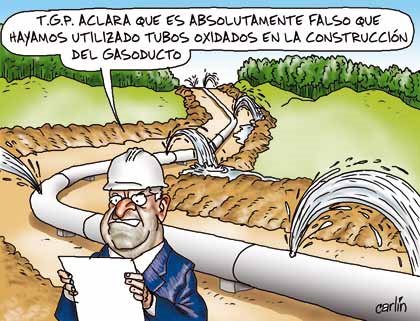
"TGP makes it clear that it is absolutely false that we have used rusted materials in construction of the pipeline"
Cartoon in La Republica

Tuesday, April 04, 2006

TGP will pay for audit

According to OSINERG, Camisea Pipeline Consortium, TGP, will foot the bill for the technical audit of the pipeline, not the Peruvian government or the IDB. Alfredo Dammert, OSINERG president, said that money will be desposited in an OSINERG account and that TGP will have no influence over the audit. He said the selection of the auditing company will be carried out by the Ministry of Energy and Mines, OSINERG (part of MEM) and the IDB.

Bill Powers, E-Tech engineer, has responded saying that this change in the audit cannot guarantee its transparency. He also pointed out that the IDB's loan conditions requiered an independent monitoring system but that the IDB has been too controlling of the design of the system and has guaranteed it's failure by only offering $40,000 to pay for it.

Interview in El Comercio with Bill Powers (Spanish)

Monday, March 27, 2006

New Report From E-Tech Find's TGP's Responses Inadequate

The consulting NGO, E-Tech International issued a new report in response to TGP contesting its defense of the construction practices it used on the Camisea pipeline. The new report reiterates claims made in its February 27, 2006 report that the pipeline ruptures are likely due to construction deficiencies including poor welding, unqualified welders and inspectors who were trained in the field, lack of erosion control during pipe construction, and the installation of segments of pipe that were rusting on the inside. It urges an immediate and evaluation of the pipeline done by an impartial actor in order to consider all apscets of the project and ensure that problems are addressed. The report recommends the Dutch Commission on Environmental Impact Assessment, which civil society organizations have been long suggesting should be contracted to independently audit the project.

E-Tech report

Friday, March 24, 2006

Peruvian poll: 54% favor renegotiating TGP contract

A poll by Peru's Universidad Nacional de Ingeniería (UNI) Concerning the Free Trade Agreement with the US (66% of Peruvians feel it should be debated further in the next Congress) also asked about Peru's contract with the Consortia Transportadora de Gas del Perú (TGP). 54.1% thought that the existing contract should be revised compared to 28.8% who felt it should stand.

El Comercio Article (in Spanish)

Tuesday, March 21, 2006

Terms of Reference Posted for Pipeline Audit

OSINERG, the regulatory agency within Peru's Ministry of Energy and Mines (MEM) has released the terms of reference for the technical audit of the Camisea pipeline. Comments are being accepted.

El Comercio reports today that within a month a company will be selected to carry out the audit. A technical group will be formed to choose the contractor which will be comprised of MEM, OSINERG (also part of MEM) and one independent representative.

In same article, OSINERG suggests that TGP might respond later this week concerning payment of the more than US$ 900,000 levied against them for previous spills and erosion during pipeline construction.

Article in El Comercio in Spanish