Thursday, May 25, 2006

Built to Spill

Chip Mitchell has a good article on the project in the Texas Observer. It describes problems with the pipeline and gives some background on Hunt Oil and its ties to the Bush campaign.

“A project of this size can expect to have some challenges,” says Jeanne Phillips, the company’s senior vice president of corporate affairs and international relations, who chaired President Bush’s 2005 inaugural committee.
We’re not worried,” says Phillips, the Hunt vice president. “We’re working with the IDB and many nongovernmental organizations to ensure that the Peru LNG project is very aggressive and progressive on the environmental front as well as the social-responsibility front.”

Not sure which NGO's Phillips is referring to.

Monday, May 08, 2006

Visit to the Lower Urubamba Valley Part 2

Summary of our trip for the Amazon Update (Amazon Alliance Newletter):

From April 23-25, 2006 a delegation organized by Oxfam America and including the Wallace Global Fund, the US Catholic Bishops' Conference, World Wildlife Fund Peru, Escuela para el Desarrollo, the Consejo Machiguenga del Rio Urubamba (COMARU), the Central de Comunidades Nativas Machiguengas (CECONAMA) and Amazon Alliance visited the Camisea Project including the installations of PlusPetrol at Malvinas and three Machiguenga communities: Chocoriari, Timpia, and Shivankoreni.

The delegation found disagreement between the company claims of strong environmental protections and social sensitivity and the reports from indigenous community members that the project that had contaminated their water sources, affected nutrition, and left little local benefit. Machiguenga communities in the area complain that the project has left them without fish in the rivers to eat and disrupted their traditional lifestyles.

The communities also expressed great dissatisfaction with the process of negotiating with companies for the use of their territories. They were particularly critical of pipeline consortium, Transportadora de Gas del Peru (TGP) and described being pressured into signing agreements with which they were not satisfied. The Machiguenga community of Timpia, which is receiving $65,000 for a 33 year easement of their territory for the pipeline, found themselves out-negotiated by the company’s trained lawyers. Neighboring community, Chocoriari will receive $60,000 for 33 years use of their territory which amounts to approximately $20 per family per year. After several pipeline spills in less than two years of operation, communities are worried about further contamination and feel that they have not been adequately compensated.

The presence of federal government regulation in the project is weak and is perceived by local communities as unfairly supporting company interests. Meanwhile, health and education needs are unmet in the Lower Urubamba region. Company personnel and Peru’s Ministry of Energy and Mines are quick to blame local and regional government officials for not investing more of the project’s royalties in the region. Communities however, are looking to their indigenous federations and non-governmental allies for assistance and objective support in evaluating the project and its impacts on their territories.

Thursday, April 06, 2006

Call for Accountability: IDB's Loan to Peruvian Government

In addition to the loan to Transportadora de Gas del Perú (TGP) in 2002, the IDB approved a $5 million loan to the Government of Peru for a program to strengthen government oversight of environmental and social issues related to Camisea.

María Elena Foronda, President of Peru's National Environment Society (Sociedad Nacional del Ambiente) is calling on Peru's government accounting office to look into how this money was spent considering the serious environemtnal adn social impacts of the project.

Peru's Grupo Técnico de Coordinación Interinstitucional (GTCI) is the entity formed in 2002 to administer these resources and consisits of 12 agencies. according to their website their last activities were in March of 2005. GTCI did not respond to La Republica's request for an interview.

Article in La Republica (Spanish)

Wednesday, April 05, 2006


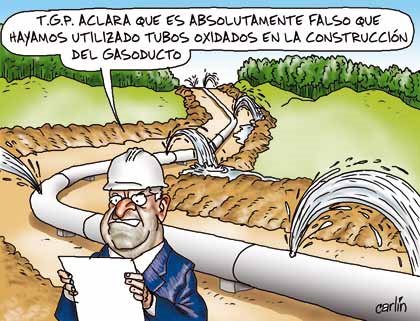
"TGP makes it clear that it is absolutely false that we have used rusted materials in construction of the pipeline"
Cartoon in La Republica

Tuesday, April 04, 2006

Préstamo para gas natural en duda

El financiamiento del Banco Interamericano de Desarrollo (BID) para el proyecto de exportación del gas natural licuado (LNG, por sus siglas en inglés) de Camisea estaría condicionado a los resultados de la auditoría a los ductos. Según informó el diario "Financial Times", el proyecto requiere US$400 millones del BID. El presidente de este organismo multilateral, Luis Alberto Moreno, recalcó que no han cerrado la posibilidad de otorgar el préstamo, aunque remarcó que sin la auditoría no se podrá continuar con la segunda fase. Fuente: El Comercio

IDB loan for Camisea II dependent on audit

The IDB told the Financial Times that new IDB loans for the Camisea project would be dependent on the outcomes of environmental and technical audits. The project consortium is looking for $400 million in loans from the IDB for the second phase of the project to liquify natural gas. Luis Alberto Moreno, the IDB president, told the FT: “We are not even close to approving the loan. Without the audit we can’t go to the second phase.”

TGP will pay for audit

According to OSINERG, Camisea Pipeline Consortium, TGP, will foot the bill for the technical audit of the pipeline, not the Peruvian government or the IDB. Alfredo Dammert, OSINERG president, said that money will be desposited in an OSINERG account and that TGP will have no influence over the audit. He said the selection of the auditing company will be carried out by the Ministry of Energy and Mines, OSINERG (part of MEM) and the IDB.

Bill Powers, E-Tech engineer, has responded saying that this change in the audit cannot guarantee its transparency. He also pointed out that the IDB's loan conditions requiered an independent monitoring system but that the IDB has been too controlling of the design of the system and has guaranteed it's failure by only offering $40,000 to pay for it.

Interview in El Comercio with Bill Powers (Spanish)

Monday, March 27, 2006

New Report From E-Tech Find's TGP's Responses Inadequate

The consulting NGO, E-Tech International issued a new report in response to TGP contesting its defense of the construction practices it used on the Camisea pipeline. The new report reiterates claims made in its February 27, 2006 report that the pipeline ruptures are likely due to construction deficiencies including poor welding, unqualified welders and inspectors who were trained in the field, lack of erosion control during pipe construction, and the installation of segments of pipe that were rusting on the inside. It urges an immediate and evaluation of the pipeline done by an impartial actor in order to consider all apscets of the project and ensure that problems are addressed. The report recommends the Dutch Commission on Environmental Impact Assessment, which civil society organizations have been long suggesting should be contracted to independently audit the project.

E-Tech report

Friday, March 24, 2006

Peruvian poll: 54% favor renegotiating TGP contract

A poll by Peru's Universidad Nacional de Ingeniería (UNI) Concerning the Free Trade Agreement with the US (66% of Peruvians feel it should be debated further in the next Congress) also asked about Peru's contract with the Consortia Transportadora de Gas del Perú (TGP). 54.1% thought that the existing contract should be revised compared to 28.8% who felt it should stand.

El Comercio Article (in Spanish)

Thursday, March 23, 2006

Peru Government to Sign 7 More Oil Contracts in April

Peru Plans 350M in Oil Investments

Lima, Mar 22 (Prensa Latina) Peru plans to award seven contracts in April, for a total 350 million dollars, for oil exploitation and exploration.

Mines and Energy Minister Glodomiro Sanchez said one of these contracts is already functioning and the others are awaiting the signature of President Alejandro Toledo.

The minister pointed out that four contracts will be signed between State Perupetro and the US Amerada Hess Corporation, which will explore in Ucayali and Loreto departments, in the country´s northeast and central regions.

He said that by the end of the year, Hunt Oil will confirm the natural gas reserve in Pagoreni near Camisea, recently in the headlines for pipeline explosions.

Tuesday, March 21, 2006

Terms of Reference Posted for Pipeline Audit

OSINERG, the regulatory agency within Peru's Ministry of Energy and Mines (MEM) has released the terms of reference for the technical audit of the Camisea pipeline. Comments are being accepted.

El Comercio reports today that within a month a company will be selected to carry out the audit. A technical group will be formed to choose the contractor which will be comprised of MEM, OSINERG (also part of MEM) and one independent representative.

In same article, OSINERG suggests that TGP might respond later this week concerning payment of the more than US$ 900,000 levied against them for previous spills and erosion during pipeline construction.

Article in El Comercio in Spanish

Monday, March 20, 2006

AIDESEP Proclamation

The indigenous organization, AIDESEP, issued the following proclamation after the fifth Camisea spill. (English Translation).


Declaration of the Interethnic Association on the Development of the Peruvian Amazon (AIDESEP)

CAMISEA Project Demonstrates Lack of Planning: Attempt on the Rights of Indigenous Peoples

2006-03-08

Aware of the current situation facing our peoples, the Interethnic Association on the Development of the Peruvian Jungle (AIDESEP) – the organization that defends and promotes the rights of indigenous peoples in the Peruvian Amazon – expresses the following:

The concurrence of the electoral process, the release of a report by a foreign monitoring company in Washington, and a new spill – which the area suffered yesterday, on March 4, 2006 – have revealed the difficult situation the Machiguenga and other indigenous peoples face and has made the press and the public question these circumstances. This reaction is due to more than just awareness of deficient environmental management, inadequate supervision, and the irresponsibility of officials from diverse institutions created to monitor the development of the CAMISEA gas mega project. It is also a result of having been the target of deception on the part of the concession company.

To avoid [late] penalties outlined in the concession contract, the company installed the liquid natural gas (LNG) pipeline haphazardly and irresponsibly, without proper safeguards, and clearly without the supervision or verification of relevant state agencies as well. It is possible to arrive at these conclusions simply through technical observation of the successive failures of the pipeline. Nevertheless, we should reiterate that we previously warned of the grave dangers posed by this project’s implementation. The ecological balance is at stake, but also principally the life and health of the Nanti, Nahua, Kugapakori, Machiguenga and other indigenous groups. We are concerned not only about these native communities but also about the groups living in voluntary isolation, one third of whose territory is superimposed upon by the Camisea gas concession.

These situations are developing as we enter the third millennium, when Peru, through R. Legislative 26253, ratified and approved ILO Convention No. 169 concerning Indigenous and Tribal and Peoples in Independent Countries. During the same period, the Second International Decade of the World’s Indigenous People was declared and adopted by the United Nations to direct effective attention to related challenges and guarantee indigenous participation at diverse levels of decision-making within State Parties. On November 24, 2004, States signed the Brazilian Declaration, and attending States made additional agreements concretizing the rights of indigenous peoples. While all these agreements are full of good intentions, they are not being applied here, much less are they recognized by the majority of Peruvian State officials. This is evident in the current reality of indigenous politics, which lacks consultation, and the Free, Prior, and Informed Consent of indigenous peoples to policies, legislative and administrative measures, programs, or projects that affect them.

Faced with such omissions, indifference, and carelessness, we, as indigenous peoples, have already lost confidence in the efficacy of the democratic system. In many cases, we have already witnessed direct attacks against collective indigenous rights in the imposition of “negotiable” grids as concessions over ancestral indigenous territories. This is a widespread problem despite severe penalties decreed by the current government.

The fact is that our peoples don’t believe the judicial system will help us resolve this problematic situation. For example, the company, which has been fined four times, still – to this day – has not paid, because it hopes to find the legal ruse needed to challenge the fines and move from an administrative venue to the courts. Despite this, the agencies responsible for environmental matters have not deigned to issue a denouncement, much less the magistrates at the Public Ministry’s office, even to prevent the crime of causing actual or potential environmental harms. The exception is the Ombudsman’s Office, which has recently released a report about the grave effects on the rights of indigenous peoples.

Considering this situation, AIDESEP demands the following:
1. The immediate suspension of the Camisea Gas project (equally important, the General Control of the Republic should intervene in order to verify fulfillment of the functions of OSINERG, INRENA, CONAM, DIGESA, DGAA of the Ministry of Energy and Mines, the CAMISEA DEFENSE, INDEPA and GTCI).
2. That an audit of the entire pipeline is carried out and a definitive suspension of the Camisea gas project is announced.
3. That, in consideration of the company’s grave breach of contract provisions, lack of ethics, trickery, and its overvaluation of material and expenses, Plus Petrol’s concession be made null and void.
4. That the Energy Tax law is modified so that communities whose natural resources are extracted can directly enjoy resulting benefits.
5. That the government stipulates that enforcement of fines against companies violating the law will occur within a certain timeframe and responsibility will not lift if there isn’t an effective deposit of the entire amount. Moreover, that said amounts will be turned directly over to affected communities.

Through this declaration the indigenous organization AIDESEP reiterates the aforementioned conclusions and demands to national state agencies, the IDB, NGOs of the world, and the press. There has been a lack of attention, recognition, and respect for the collective human rights of indigenous peoples, as well as State exploitation of natural resources inside our ancestral territories – territories we possessed long before colonization and formation of the current national State. In light of this, we declare our lands – the soils and subsoils – as defined within internal agreements made during AIDESEP’s 20th National Congress and the Second Continental Summit of the indigenous peoples ABYA YALA and others, to be as they always have been: imprescriptible, inalienable, unembargoable, and unexpropriable.

Cordially,

Leadership Council of AIDESEP

Hunt Oil Quickly Bags State Investment Contract

La República reports today about how Hunt Oil Company was able to get the Peruvian Congress to approve in only 8 hours its contract to build the Camisea Gas Liquification Plant in la pampa de Santa Melchorita, en Cañete and furthermore how it took Hunt only 40 days to sign a US$ 290 million investment contract with ProInversion, Peru's Private Investment Promotion Agency.

The ProInversion Board consists of 7 ministers, one of whom is Peru's Prime Minister, Pedro Pablo Kuczynski, consultant to Hunt Oil and formerly on the board of TGP shareholder Tenaris. He also worked for the InterAmerican Development Bank which financed the Camisea pipeline.

Article in Spanish

Sunday, March 19, 2006

Blog de Camisea

This is my first entry on this Blog tracking the Camisea Gas Project in Peru.

Camisea is Peru's largest hydrocarbon project, an effort to pump and pipe 11 trillion cubic feet of natural gas from the Amazon to the Coast. It is also an extremely destructive project that has brought environmental devastation and disease to indigenous peoples in the Amazon, some of which have had little or no contact with the outside world.

I have been following the Camisea project since 1996 when I worked in the region with the Peruvian NGO, CEDIA and the local indigenous organization, COMARU.

I plan to use this Blog to post news, reports, and other observations about the project. I look forward to your comments as well.