Thursday, January 25, 2007

Malvinas: Corners Cut in Corrosion Prevention


In a piece called "Camisea: complicidades y negligencias," reporter, Herbert Mujica Rojas, brings to light Report No. 080-2005-CR/JVR from May 2005, to Peru's Congressional Committee for Fiscalización y Contraloría. The commission found evidence that the consortium Sade Skanska Latintecna JJC (today known as Skanska Peru) did not comply with technical specifications for corrosion prevention in the high temperature pipelines for the Camisea Gas Project and that this was known by Plus Petrol. OSINERG aknowledged the claim made by Skanska subcontractor, Eldaco SAC, the company hired to carry-out Cathodic protection of the high temperature pipelines in Las Malvinas.

The Commission report concludes that OSINERG knew this when it issued a report distorting and hiding the truth by referring to out-of-date Technical Standards when it said that it had detected no violations with respect to the security of the installations. It also accuses the Director General for Hydrocarbons and the Ministry of Energy and Mines of negligence in making claims about the project that contradicted the evidence.

Apparently, Skanska was responsible for building the Malvinas plant, where the gas from the San Martin and Pagoreni gas fields are collected, separated, and sent through the pipeline. Malvinas has the capacity to process 440 million cubic feet of natural gas and 30 thousand barrels of gas condensate each day. Skanska subcontracted Eldaco to apply cathodic protection to pipes that handle high temperature gas (>600ºC). The technical specifications of the treatment were to apply one layer of inorganic zinc and a second layer of silicone to the pipes, both necessary to prevent premature corrosion of the pipes and explosion of the volatile contents. Eldaco claims that Skanska, running behind in completion of the plant, cut corners and ordered the subcontractor to only apply the zinc coating, thus violating project specs. An Eldaco manager provides an account of this in the comments of this article in Servindi.

Tuesday, January 16, 2007

Camisea II: Hunt Oil May Build Second Pipeline in Amazon


Since October, we have been hearing diverse accounts that Peru LNG - the consortium led by Hunt Oil (US) and including SK Corporation (South Korea) and Repsol YPF (Spain) is considering building a second pipeline originating from the Las Malvinas facility in the Lower Urubamba region to feed its LNG plant in Pampa Melchorita with gas from Block 56. According to the Peru LNG's website, and the InterAmerican Development Bank (IDB), which is considering financing the project, the second pipeline was supposed to be built only from the coast to the edge of the jungle in Ayacucho. The reasoning has always been that constructing a new pipeline in the Amazon jungle would cause additional environmental damage to an extremely sensitive region. The original Camisea gas pipeline was supposedly sized large enough in anticipation of the additional gas from Block 56.

Now, however, Hunt is looking seriously at the possibility of constructing a second pipeline in the Amazon. Peru's Ministry of Energy and Mines (MEM) and its natural resource agency (INRENA) held consultations with local organizations in Quillabamba in November about the proposed second pipeline. In late November, a senior official with MEM told me that a second pipeline in the Amazon was in the planning and that it was needed because Peru's internal demand for gas has far exceeded expectations. This argument does not make much sense because the new pipeline would be build by Peru LNG to feed their LNG export facility. Besides, according to El Comercio, Camisea operator, Pluspetrol has not managed to offer gas at a price that has been attractive to industry. In a recent interview with Reuters, PeruPetro President, Cesar Gutierrez said, "The conversion to gas in industry has been limited and the conversion for domestic use is almost nil."

A more likely reason why Hunt is looking into the second pipeline is that Peru LNG could not come to agreement with TGP over the cost of transporting gas through the existing pipeline. Quality concerns with the pipeline may be another factor.

In December, I spoke with Lelis Rivera, Director of CEDIA, who has worked in the Upper and Lower Urubamba for three decades. He predicts that a second pipeline in the Amazon could not be routed alongside the existing liquid and gas pipelines. The existing pipelines were built along steep ridgelines and subsequent erosion has left little room to add another pipe. In some places, erosion of the ridgeline has been so bad that it has exposed the pipeline.

If Hunt does decide to build a second pipeline in the Amazon, the impacts on indigenous communities and the ecosystem will be as extreme. In a 2003 report on the construction of the first pipeline, Global Village Engineers Global Village Engineers estimated that the clearing and exposure of the right-of-way in the Amazon caused as much as 100 tons of soil and vegetation per meter of pipeline eroding into sensitive aquatic habitat. This left local indigenous communities without clean water or fish to eat.

Thursday, January 11, 2007

The Camisea Chronicles


Check out Indian Country Today's recent three-part series on the Camisea Project. Reporter Lisa Garrigues visited communities in the Upper and Lower Urubamba as well as Quillabamba and reports on the conditions in the Machiguenga, Yine, and Quechua communities.

Garrigues offers an in-depth report on the changes in health, nutrition and culture in indigenous communities since the project began.

Here's a taste from the first installment on December 18, 2006:
Dr. Meliton Concha, director of indigenous health for the Quillabamba region, attributed the deterioration of Machiguenga health directly to dietary changes brought on by gas company activities. ''Before, there were fish and birds in abundance. Now the rivers are impoverished.''

Ciro Miranda, of the nongovernmental organization CEDIA, said the money negotiated in river access deals with Pluspetrol for three-year river exploration rights, which can range from $10,000 to $89,000, is minimal for the needs of the communities. Pluspetrol requires that the community present a project to them before they will disburse the funds. The projects don't always immediately alleviate malnutrition.

The series discusses some of the cultural impacts on the Machiguenga communities:

The buzz of helicopters, the churning waters of transport boats, the gas leaks that caused fish to die and skin to burn have been continual reminders in this territory that was once exclusive to the Machiguenga and other peoples.

Part 2 mentions health problems that have intensified since the project began including respiratory disease, diarrhea and syphilis.

In Part 3 of the series, Garrigues writes about what the government and companies have done to silence public criticism of the project including: cutting the budget of the Defensoria del Pueblo and thus forcing it to close it's office in Quillabamba; paying off media to slant coverage of the project; and shutting down a local television station that ran an investigative story about the project.

Photo by Adam M. Goldstein

Friday, January 05, 2007

E-Tech Questions TGP's Latest Pipeline Report


Peru's news daily, La Primera, has an interview with E-Tech International engineer, Bill Powers who shares his skepticism of TGP's latest report on the status of the Camisea Pipeline. He accuses TGP of placing the blame for multiple pipeline spills on mother nature while having not taken the time to adequately control erosion during pipeline construction. He also says that TGP's "intelligent pigging" tests are not capable of detecting the fundamental problem of substandard welding - a problem that requires radiography to identify.

Power's also questioned how the firm Germanisher Lloyd, which has been contracted by the Peruvian government to perform a technical audit of the pipeline, would be able to carry out a proper field assessment during the height of the rainy season in the Amazon.

Rigzone reports that TGP will invest an additional $85 million in the pipeline in 2007. It quotes TGP General Manager, Ricardo Ferreiro, as saying that "The pipeline is in perfect condition" and that their testing has found only 30 small scratches or dents in the pipeline.

Peru's New Petroleum Concession Map Covers Most of Amazon


Perupetro SA, Peru's state company responsible for promoting hydrocarbon exploration and development recently released a new map showing existing and planned concession blocks. The new map shows a number of new areas of the Peruvian Amazon now open for oil and gas exploration including the Sierra del Divisor Reserve Zone that borders Brazil. The portion of Peru's 67 million hectares of Amazon rainforest that is slated for oil exploration now exceeds the 50% reported on December 4, 2006 by the Environmental News Service.

According to Rigzone, Perupetro signed a record 16 contracts with private companies for oil and gas exploration and exploitation in 2006 and is putting another 18 on the auction block in 2007, which it will promote in at a roadshow in Houston this month.

Thursday, November 02, 2006

Peruvian Comission to Evaluate Compliance with IDB Loan Conditions

An October 27 Ministerial Resolution has created a multi-sectoral committee reporting to the Ministry of Energy and Mines (MEM) in order to ensure compliance with the environmental and social conditions of the InterAmerican Development Bank (IDB) loan, and to determine possible changes in the government's management of the project. The commission will be comprised of MEM, the Peruvian Finance Ministry, Ministry of Agriculture, Ministry of Health, INDEPA (institute for indigenous and afroperuvians), National Institute for Natural Resources (INRENA), the National Comission of Environment (CONAM), and the Supervisory Agency for Energy (OSINERG). The Camisea coordinating body, GTCI, will be the secretariat. Notably, Peru's Public Ombudsperon (Defensoria del Pueblo) is not included, nor any civil society organizations.

The committee is tasked with developing and action plan that includes:
Improving the Camisea Fund, aka FOCAM;
Improving compensation and indemnity procedures for affected communities;
Improve legal access in relation to defense of protected areas and indigenous territorial reserves;
Increase the presence of the government in the project area in support of an integrated monitoring plan;
Support the Protection Plan for the Nahua Kugakapori Reserve for Indigenous Peoples living in voluntary isolation;
Implement mechanisms for participatory sustainable development in the Lower Urubamba valley;
Ensure adequate resources for protected areas;
Improve communication with civil society in the areas of influence of the project; and
Strengthen the function of PROPARACAS.

This committee is forming at the same time that the IDB is contracting ICF International to carry out its own four-month environmental and social audit of the Camisea project.

Thursday, July 13, 2006

US Senate Foreign Relations Committee Hearing Looks at Camisea

The July12th hearing of the US SFRC examined the effectiveness of mutlilaterlal intestments in large infrastructure. Witnesses speaking on Camisea included Clay Lowry, Assistant Secretart for International Affairs for the US Treasury Department; Jaime Quijandria, Executive Director for Argentina, Bolivia, Chile, Paraguay, Peru and Uruguay at the World Bank and ardent Camisea supporter; and Carlos Herrera Descalzi, Former Minister of Energy and Mines of Peru, who has been critical of the way the Camisea contracts have been modified to favor natural gas export over meeting Peru's energy security needs.

The hearing room was packed with InterAmerican Development Bank staff, press, and many NGO's tracking the project.

The most impressive quote came from Lowry who told the committee, "We are of the view Camisea has not been a success. It could have been better designed." He also said, as quoted in Reuters:

"The IADB's role is to catalyze, not fill gaps in financing," Lowery said. "Because they came in late in the game they were not involved in the environmental and social safeguards," he added. "As to how the United States will vote, or look at Camisea 2, we haven't decided yet."

"The IADB does have fairly significant resources in terms of environmental and compliance issues. Where they probably made mistakes on Camisea 1 was underestimating how much it would take to make the project work,"


Herrera, who signed the original contracts with the Camisea consortium when he was Peru'[s Energy Minister said that the development of Camisea II (export phase) should not come at the cost of this original objective of Camisea I which was energy security for Peru.

Quijandria's testimony seemed to be taken verbatim from the IDB's propaganda on the project. He described the project as "the largest and mowt complex project in Peru's history" and attrributed it to lowering energy prices in Peru.

The real story is more complex. End consumer energy prices in Peru were held artificially low in Peru while Quijandria was Energy Minister, and so producers lost money and stop generating, creating an energy crisis. In fact, little of Peru's energy infrastructure is built to operate with natural gas, an excuse project sponsors have used to justify its export. However, by the time natural gas infrastructure is developed in Peru, export will be well on its way and Peru could ironically wind-up importing gas at world prices.

Wednesday, June 28, 2006

Dallas Morning News Gets a Few Facts Wrong

The Dallas Morning News published an article by Jim Landers "Hunt Oil Making Big Play in Peru." The article gets some basic facts right about the project, but makes many blunders, too. A few inaccuracies:

The article claims that NGO Amazon Watch "hired engineers who said the pipe steel and welds were defective." This refers to a study done by the NGO E-Tech International, that was not paid for by Amazon Watch.

According to the article, Barbara Bruce, Hunt's general manager of Peru LNG said, "the first of five leaks in the gas liquids line was caused by a weak weld." In the next paragraph, the article states that the companies insist that the welds are not fault and that the Inter-American Development Bank's auditors have found no problems so far with the quality of the pipe.

The map incorrectly shows the new pipeline (blue) will be constructed going from the Amazon region (Campo Las Malvinas), to the coast at Pampa Melchorita. In fact, the companies indicate that they are not laying a new pipeline in the Amazon region because of the environmental risks.

Of the existing pipeline, the article claims that they "were built in the six-month dry season of 2003-04." Actually, the right-of-way for much of the pipeline in the Amazon region was cleared in 2002. Because of delays in construction, some areas of the pipeline were subjected to two rainy seasons before they were reforested, resulting in excess erosion documented here.

According to Carlos Abanto of the Lima-based association, Labor. He never said: "If the IDB participates, it will be much better." as was quoted in the article. He did say that the IDB claims its participation in the project to be a guarantee for the project, but that this has not occurred as evidences by the spills, community problems, and contamination.

Some other interesting quotes from the article:

About 600 people are now walking the line to identify weak points, clear them out and clean them out," said Ms. Bruce.

But I think the consortium is a very responsible group of guys. ... In the end, Hunt will do well here." Prime Minister Pedro-Pablo Kuczynski who is a former advisor to Hunt Oil.

Mr. Garcia met with Hunt officials last week, and endorsed the Camisea project "wholeheartedly," Steve Suellentrop, Hunt Oil.

Wednesday, June 21, 2006

Peruvian Congressional Committee Recommends Renegotiating Camisea Contract

A Peruvian congressional committee issued a report yesterday evaluating the impacts of pipeline accidents. The report confirms that the project has contaminated the environmental in the neighboring indigenous communities. It also contains 17 recommendations, among them that the government renegotiate the contract for Block 88. The president of the commission, Carlos Armas, assigned responsibility for the accidents to the contractors Pluspetrol, TGP, Techint, the Ministry of Energy and Mines, and regulator OSINERG. He also called for the removal of OSINERG president, Alfredo Dammert. The report will now be debated by the Congress and submitted to the Public Ministry which will investigate if there have been any violations of the law.

Article in La Republica (in Spanish)

Friday, June 16, 2006

Dallas Morning News: Garcia Win 'Good News' for Petroleum Companies

Columnist Jim Landers of the Dallas Morning News writes from Pluspetrol's Malvinas camp to say that Alan Garcia's win in Peru's elections is "good news" for multinational petroleum companies." From the article:

The oil companies argue that Camisea is clearly Peru's golden goose. And there is much more to come.

Hunt Oil has the lead for the next big expansion from Camisea, which will be a $2.5 billion liquefied natural gas export project. A new pipeline across the Andes will deliver the gas to a Pacific coast liquefaction plant, where superchilled tankers will take the LNG to markets in Mexico and California.

That will mean a lot more money for Peru. It will also, of course, make money for Hunt and its LNG partners in Spain, South Korea and France.


Article in the Dallas Morning News

Tuesday, June 13, 2006

Alan Garcia Government will Renegotiate Camisea Contract

Following up on a campaign promise, the Director Economy for President Elect Alan Garcia's Apra party, Enrique Cornejo, confirmed that the new government would renegotiate its contract with the Camisea consortium within 6 months of taking office. Reason given: increase in oil prices since the contract had been signed. Peru 21 article (Spanish).

Dead Fish Prompt Rumors of New Camisea Spill

As of June 6, 2006, several communications have come from organizations working in the Lower Urubamba including the Machiguenga council, COMARU and the Escuela para el Desarrollo have reported evidence of some contaminant in the Camisea River that has been killing fish. The Community Monitoring Program (PMAC) has not yet issued a report. Pluspetrol has evidently denied that there has been any spill and has blamed the fish deaths on the use of the toxic plant barbasco for fishing in one of the Camisea's tributaries in the community of Segakiato. Tensions are apparently high between the company and the communities, and the latter are calling for independent experts to come and assess the reason for the fish dye-off. The communities are reporting a contaminant much stronger than the traditionally-used barbasco.

Ministry of Energy and Mines Will Announce Pipeline Auditor in July

On July 13, 2006, Peru's MEM will announce the company or consortium that will carry out an independent audit of the Camisea Gas project. The government's audit will examine the design, construction, and materials used in the pipeline's construction and any risks to public security. The audit is being financed by the pipeline consortium, TGP, through an agreement with the Peruvian government. Since the project began operation in August 2004, there have been five accidents, including an explosion in March that left local residents hospitalized.

Thursday, May 25, 2006

Built to Spill

Chip Mitchell has a good article on the project in the Texas Observer. It describes problems with the pipeline and gives some background on Hunt Oil and its ties to the Bush campaign.

“A project of this size can expect to have some challenges,” says Jeanne Phillips, the company’s senior vice president of corporate affairs and international relations, who chaired President Bush’s 2005 inaugural committee.
We’re not worried,” says Phillips, the Hunt vice president. “We’re working with the IDB and many nongovernmental organizations to ensure that the Peru LNG project is very aggressive and progressive on the environmental front as well as the social-responsibility front.”

Not sure which NGO's Phillips is referring to.

Monday, May 08, 2006

Visit to the Lower Urubamba Valley Part 2

Summary of our trip for the Amazon Update (Amazon Alliance Newletter):

From April 23-25, 2006 a delegation organized by Oxfam America and including the Wallace Global Fund, the US Catholic Bishops' Conference, World Wildlife Fund Peru, Escuela para el Desarrollo, the Consejo Machiguenga del Rio Urubamba (COMARU), the Central de Comunidades Nativas Machiguengas (CECONAMA) and Amazon Alliance visited the Camisea Project including the installations of PlusPetrol at Malvinas and three Machiguenga communities: Chocoriari, Timpia, and Shivankoreni.

The delegation found disagreement between the company claims of strong environmental protections and social sensitivity and the reports from indigenous community members that the project that had contaminated their water sources, affected nutrition, and left little local benefit. Machiguenga communities in the area complain that the project has left them without fish in the rivers to eat and disrupted their traditional lifestyles.

The communities also expressed great dissatisfaction with the process of negotiating with companies for the use of their territories. They were particularly critical of pipeline consortium, Transportadora de Gas del Peru (TGP) and described being pressured into signing agreements with which they were not satisfied. The Machiguenga community of Timpia, which is receiving $65,000 for a 33 year easement of their territory for the pipeline, found themselves out-negotiated by the company’s trained lawyers. Neighboring community, Chocoriari will receive $60,000 for 33 years use of their territory which amounts to approximately $20 per family per year. After several pipeline spills in less than two years of operation, communities are worried about further contamination and feel that they have not been adequately compensated.

The presence of federal government regulation in the project is weak and is perceived by local communities as unfairly supporting company interests. Meanwhile, health and education needs are unmet in the Lower Urubamba region. Company personnel and Peru’s Ministry of Energy and Mines are quick to blame local and regional government officials for not investing more of the project’s royalties in the region. Communities however, are looking to their indigenous federations and non-governmental allies for assistance and objective support in evaluating the project and its impacts on their territories.

Thursday, April 06, 2006

Call for Accountability: IDB's Loan to Peruvian Government

In addition to the loan to Transportadora de Gas del Perú (TGP) in 2002, the IDB approved a $5 million loan to the Government of Peru for a program to strengthen government oversight of environmental and social issues related to Camisea.

María Elena Foronda, President of Peru's National Environment Society (Sociedad Nacional del Ambiente) is calling on Peru's government accounting office to look into how this money was spent considering the serious environemtnal adn social impacts of the project.

Peru's Grupo Técnico de Coordinación Interinstitucional (GTCI) is the entity formed in 2002 to administer these resources and consisits of 12 agencies. according to their website their last activities were in March of 2005. GTCI did not respond to La Republica's request for an interview.

Article in La Republica (Spanish)

Wednesday, April 05, 2006


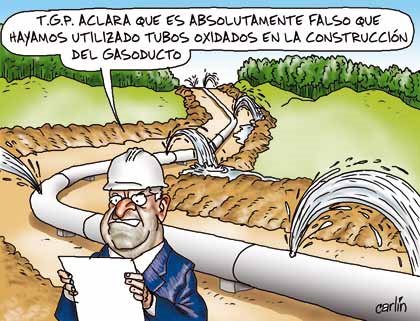
"TGP makes it clear that it is absolutely false that we have used rusted materials in construction of the pipeline"
Cartoon in La Republica

Tuesday, April 04, 2006

Préstamo para gas natural en duda

El financiamiento del Banco Interamericano de Desarrollo (BID) para el proyecto de exportación del gas natural licuado (LNG, por sus siglas en inglés) de Camisea estaría condicionado a los resultados de la auditoría a los ductos. Según informó el diario "Financial Times", el proyecto requiere US$400 millones del BID. El presidente de este organismo multilateral, Luis Alberto Moreno, recalcó que no han cerrado la posibilidad de otorgar el préstamo, aunque remarcó que sin la auditoría no se podrá continuar con la segunda fase. Fuente: El Comercio

IDB loan for Camisea II dependent on audit

The IDB told the Financial Times that new IDB loans for the Camisea project would be dependent on the outcomes of environmental and technical audits. The project consortium is looking for $400 million in loans from the IDB for the second phase of the project to liquify natural gas. Luis Alberto Moreno, the IDB president, told the FT: “We are not even close to approving the loan. Without the audit we can’t go to the second phase.”

TGP will pay for audit

According to OSINERG, Camisea Pipeline Consortium, TGP, will foot the bill for the technical audit of the pipeline, not the Peruvian government or the IDB. Alfredo Dammert, OSINERG president, said that money will be desposited in an OSINERG account and that TGP will have no influence over the audit. He said the selection of the auditing company will be carried out by the Ministry of Energy and Mines, OSINERG (part of MEM) and the IDB.

Bill Powers, E-Tech engineer, has responded saying that this change in the audit cannot guarantee its transparency. He also pointed out that the IDB's loan conditions requiered an independent monitoring system but that the IDB has been too controlling of the design of the system and has guaranteed it's failure by only offering $40,000 to pay for it.

Interview in El Comercio with Bill Powers (Spanish)